

Reports
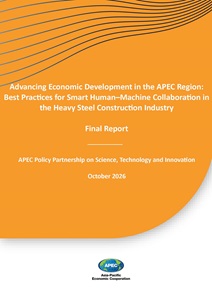
Advancing Economic Development in the APEC Region: Best Practices for Smart Human–Machine Collaboration in the Heavy Steel Construction Industry
The Asia-Pacific Economic Cooperation (APEC) is a regional economic forum established in 1989 to leverage the growing interdependence of the Asia-Pacific.
The Asia-Pacific Economic Cooperation (APEC) is a regional economic forum established in 1989 to leverage the growing interdependence of the Asia-Pacific.
APEC ensures that goods, services, investment and people move easily across borders. Members facilitate this trade through faster customs procedures at borders; more favorable business climates behind the border; and aligning regulations and standards across the region.
APEC ensures that goods, services, investment and people move easily across borders. Members facilitate this trade through faster customs procedures at borders; more favorable business climates behind the border; and aligning regulations and standards across the region.
APEC has helped drive economic growth and cooperation across the Asia-Pacific by reducing trade barriers, improving the ease of doing business and strengthening connectivity among economies. These efforts have contributed to rising incomes, expanded trade and greater opportunities for businesses and communities across the region.
APEC has helped drive economic growth and cooperation across the Asia-Pacific by reducing trade barriers, improving the ease of doing business and strengthening connectivity among economies. These efforts have contributed to rising incomes, expanded trade and greater opportunities for businesses and communities across the region.
APEC brings together governments, businesses and stakeholders to collaborate on shared priorities. Explore opportunities to participate in events, contribute to initiatives and engage with APEC’s work across the region.
APEC brings together governments, businesses and stakeholders to collaborate on shared priorities. Explore opportunities to participate in events, contribute to initiatives and engage with APEC’s work across the region.
Reports
•July 2024
Download Report
952KB
Published Under
SOM Steering Committee on Economic and Technical Cooperation (SCE), Human Resources Development Working Group (HRDWG)
Accessed
1841
Pages
37
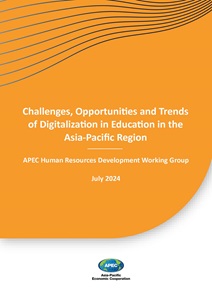
The report starts with an analysis of the digital education governance of APEC members including specialized agencies, cross-sector approach, decentralized system and mixed approach. The most recent developments of digitalization in education of APEC member feature innovative digital platforms, government-led initiatives and improvement of access to devices and connectivity. In retrospect, APEC economies have developed and implemented laws, strategies, plans, policies and action plans as well as standards and frameworks to advance the digitalization in education, aligned with larger strategy or policy at economy level. These were translated into commitments for harnessing the power of technologies, transforming the educational processes, rebuilding digital governance systems and closing digital divide. The best practices of digitalization in education are highlighted from four perspectives: enabling conditions; financing digitalization; steering innovation; and forging partnerships. Moving forward, the policy recommendations are proposed, summarized as a “SEA+ 5C” approach that stand for Structure, Enablers and Accountability with commitment, connection, content, coordination and capacity.
Reports
Advancing Economic Development in the APEC Region: Best Practices for Smart Human–Machine Collaboration in the Heavy Steel Construction Industry

Proceedings
APEC Workshop on Shaping Digital Transformation in Accreditation
Manuals
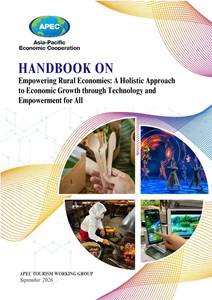
Empowering Rural Economies: A Holistic Approach to Economic Growth through Technology and Empowerment for All