

Proceedings
Workshop on Collaboration Mechanism among APEC Economies to Link Local Development with Disaster Risk Reduction Measures Intensified by Climate Change
The Asia-Pacific Economic Cooperation (APEC) is a regional economic forum established in 1989 to leverage the growing interdependence of the Asia-Pacific.
The Asia-Pacific Economic Cooperation (APEC) is a regional economic forum established in 1989 to leverage the growing interdependence of the Asia-Pacific.
APEC ensures that goods, services, investment and people move easily across borders. Members facilitate this trade through faster customs procedures at borders; more favorable business climates behind the border; and aligning regulations and standards across the region.
APEC ensures that goods, services, investment and people move easily across borders. Members facilitate this trade through faster customs procedures at borders; more favorable business climates behind the border; and aligning regulations and standards across the region.
APEC has helped drive economic growth and cooperation across the Asia-Pacific by reducing trade barriers, improving the ease of doing business and strengthening connectivity among economies. These efforts have contributed to rising incomes, expanded trade and greater opportunities for businesses and communities across the region.
APEC has helped drive economic growth and cooperation across the Asia-Pacific by reducing trade barriers, improving the ease of doing business and strengthening connectivity among economies. These efforts have contributed to rising incomes, expanded trade and greater opportunities for businesses and communities across the region.
APEC brings together governments, businesses and stakeholders to collaborate on shared priorities. Explore opportunities to participate in events, contribute to initiatives and engage with APEC’s work across the region.
APEC brings together governments, businesses and stakeholders to collaborate on shared priorities. Explore opportunities to participate in events, contribute to initiatives and engage with APEC’s work across the region.
Reports
•October 2026
Download Report
1MB
Published Under
SOM Steering Committee on Economic and Technical Cooperation (SCE), Agricultural Technical Cooperation Working Group (ATCWG)
Accessed
12
Pages
78
The APEC Food Security Roadmap Towards 2030 identifies reducing food loss and waste (FLW) as a key action under its sustainability pillar and calls for member economies to align their efforts with Sustainable Development Goal (SDG) Target 12.3. As the lead economy for Action 17(e), Chinese Taipei coordinated this progress review to assess achievements across APEC member economies using the Target–Measure–Action (TMA) framework promoted by Champions 12.3.
This progress review demonstrates that APEC economies have made meaningful progress across all three dimensions of the TMA framework. Political commitment has expanded, measurement capacity is improving, and practical actions are becoming increasingly comprehensive. Nevertheless, progress remains uneven, highlighting the need to strengthen harmonized measurement, improve food loss data, scale up digital innovation, expand investment in post-harvest and cold-chain infrastructure, and deepen public-private partnerships.
Proceedings
Workshop on Collaboration Mechanism among APEC Economies to Link Local Development with Disaster Risk Reduction Measures Intensified by Climate Change
Proceedings
Empowering Inclusive APEC Resilient City and Community for Sustainable Development
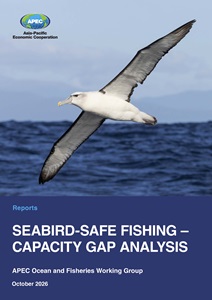
Reports
Seabird-Safe Fishing – Capacity Gap Analysis